ui/ux
ui/ux
media
media
Franceinfo Live
Franceinfo Live
Franceinfo Live

About project
About project
About project
Franceinfo Live – Designing the Pulse of Real-Time News
Franceinfo Live – Designing the Pulse of Real-Time News
Franceinfo Live – Designing the Pulse of Real-Time News
Franceinfo’s Live feed is the platform’s heartbeat: a high-traffic, real-time stream of breaking news and verified reporting. For users, it’s the go-to destination for following major events with speed and reliability.
As the Lead UX/UI Designer on this project, I tackled a dual challenge: redesigning the public-facing experience to be more readable and interaction-driven, while simultaneously optimizing the internal back-office tool used by journalists to broadcast content under pressure.
This case study focuses on the Live feed’s evolution, moving from a static news flow to a modern, engaging, and interaction-driven experience.
Franceinfo’s Live feed is the platform’s heartbeat: a high-traffic, real-time stream of breaking news and verified reporting. For users, it’s the go-to destination for following major events with speed and reliability.
As the Lead UX/UI Designer on this project, I tackled a dual challenge: redesigning the public-facing experience to be more readable and interaction-driven, while simultaneously optimizing the internal back-office tool used by journalists to broadcast content under pressure.
This case study focuses on the Live feed’s evolution, moving from a static news flow to a modern, engaging, and interaction-driven experience.

user interactions
scroll depth
returning Visitor Growth
Problem
Problem
Problem
Designing for the Speed of News
Live news is inherently chaotic. Information breaks fast, evolves instantly, and develops minute by minute. In this high-pressure environment, we faced a double-sided challenge:
1. The User Experience (Front-end) The previous interface struggled to keep pace with modern consumption habits. Users were facing:
Information Overload: During major breaking news, the sheer volume of updates became overwhelming and difficult to scan.
Monotonous Hierarchy: A lack of visual distinction between a crucial "Breaking News" alert and a minor contextual update.
Static Content: The feed felt "read-only," lacking the modern interactive elements (polls, Q&As, live media) that today's audience expects.
2. The Editorial Experience (Back-office) Behind the scenes, journalists were battling friction. Their tools weren't optimized for the "Live" reality:
Publishing Friction: A legacy system that didn't allow for the lightning-fast, error-free posting required during a crisis.
Rigid Templates: Difficulty in integrating diverse media types or interactive modules on the fly.
Workflow Bottlenecks: A management interface that felt disconnected from the dynamic nature of the final public feed.
Designing for the Speed of News
Live news is inherently chaotic. Information breaks fast, evolves instantly, and develops minute by minute. In this high-pressure environment, we faced a double-sided challenge:
1. The User Experience (Front-end) The previous interface struggled to keep pace with modern consumption habits. Users were facing:
Information Overload: During major breaking news, the sheer volume of updates became overwhelming and difficult to scan.
Monotonous Hierarchy: A lack of visual distinction between a crucial "Breaking News" alert and a minor contextual update.
Static Content: The feed felt "read-only," lacking the modern interactive elements (polls, Q&As, live media) that today's audience expects.
2. The Editorial Experience (Back-office) Behind the scenes, journalists were battling friction. Their tools weren't optimized for the "Live" reality:
Publishing Friction: A legacy system that didn't allow for the lightning-fast, error-free posting required during a crisis.
Rigid Templates: Difficulty in integrating diverse media types or interactive modules on the fly.
Workflow Bottlenecks: A management interface that felt disconnected from the dynamic nature of the final public feed.
Solution
Solution
Solution
From a News Feed to an Interactive Experience
I approached the redesign with a dual focus: creating a rhythmic, engaging experience for the audience and a frictionless, modular environment for the newsroom.
1. Reimagining the Live Feed (Front-end)
I restructured the interface to move beyond a simple vertical list. The goal was to introduce visual rhythm and active participation:
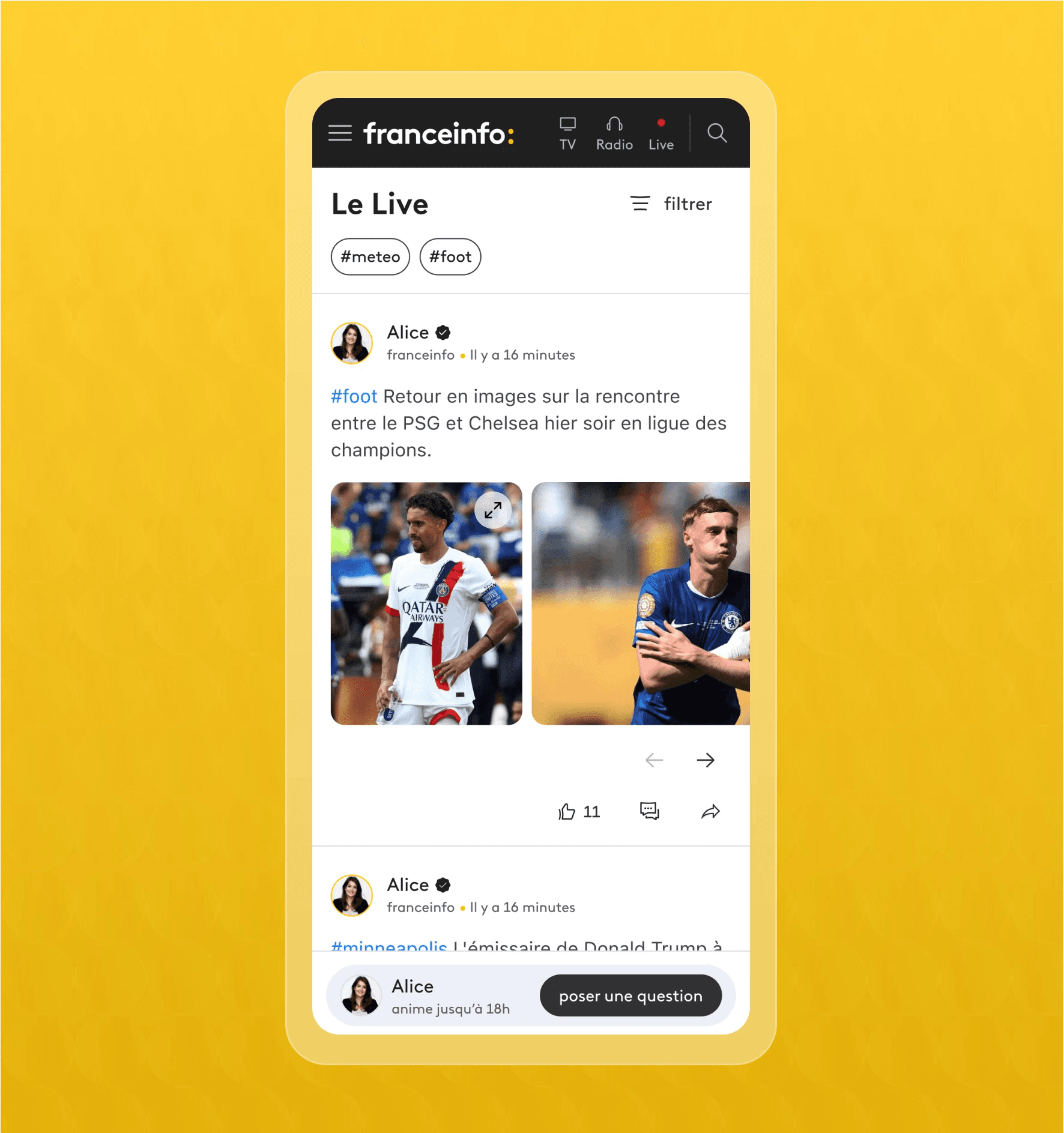
Rich Media Integration: I designed custom modules for immersive slideshows and native video players, allowing users to consume visual reporting without leaving the stream.
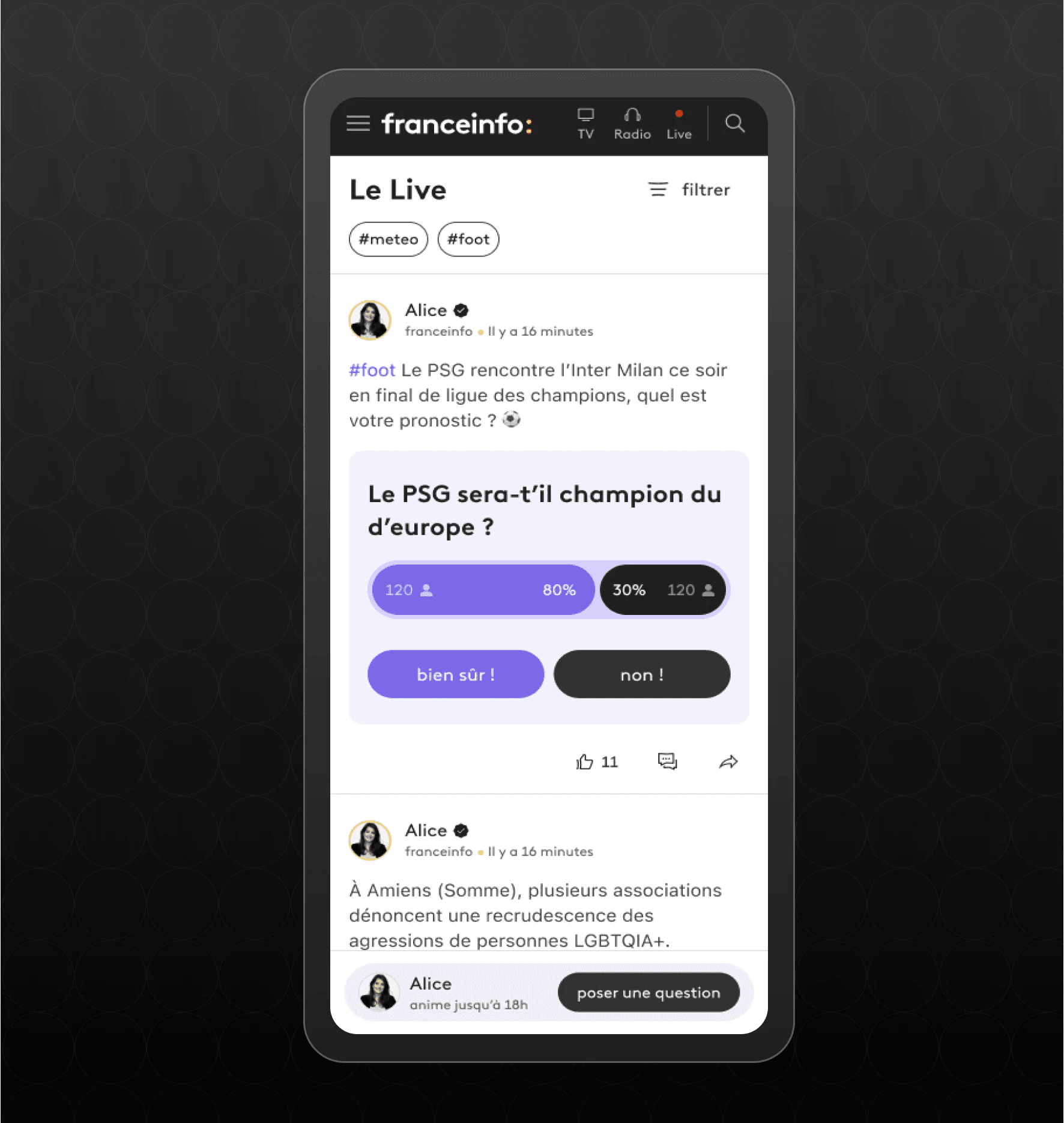
Interactive Engagement: To transform passive readers into active participants, I introduced Live Polls, Quizzes, and Predictions (sports scores).
Direct Newsroom Connection: I implemented a "Ask the Journalist" feature, creating a bridge between the audience and the field in real time.
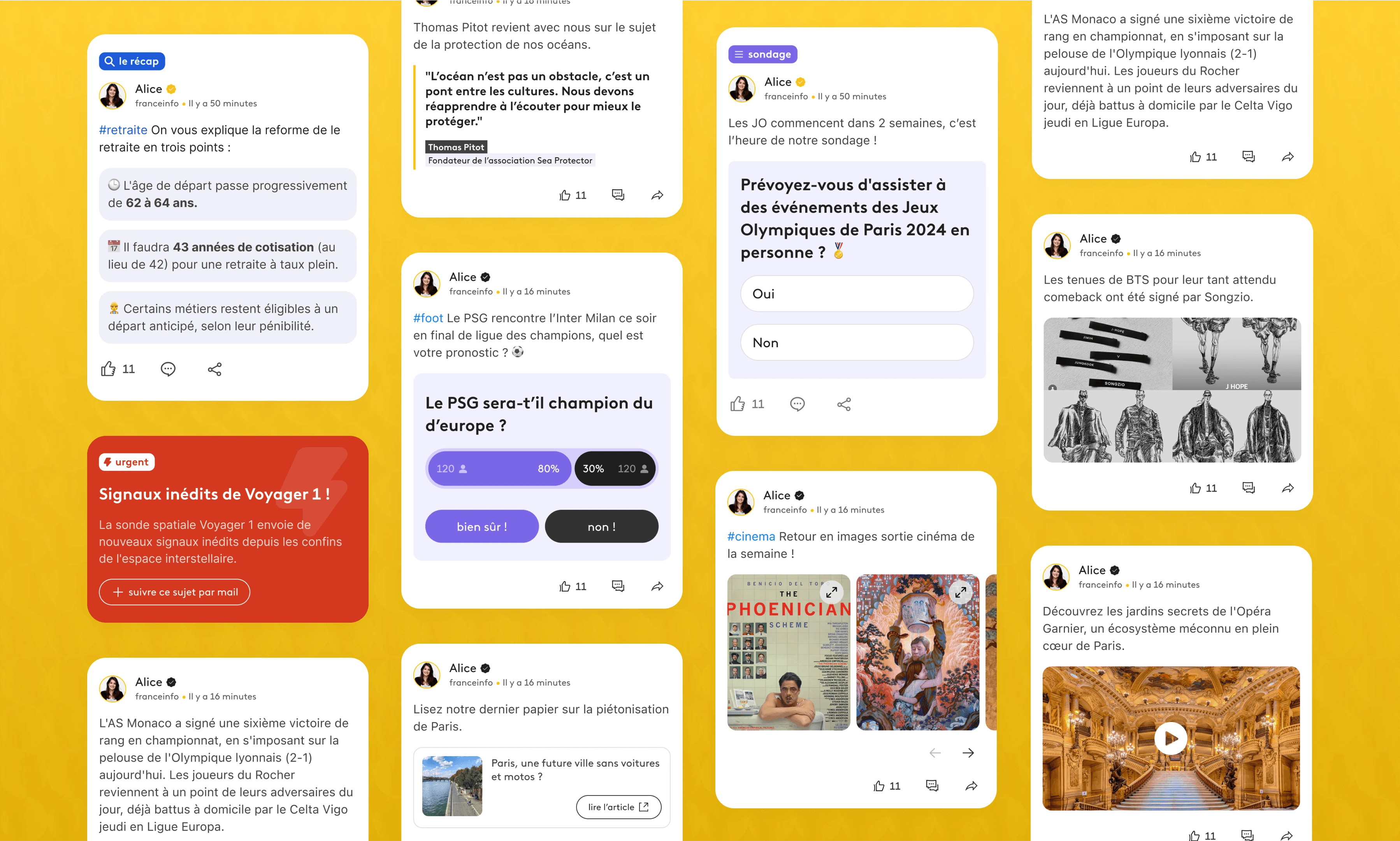
Smart Hierarchy: Visual cues and distinct cards now differentiate between "Breaking News," "Fact-checks," and "Contextual Updates," making the feed scannable at a glance.
2. Empowering the Newsroom (Back-office)
The internal tool was redesigned to handle this new complexity without adding cognitive load for journalists:
Component-Based Publishing: A modular "drag-and-drop" style interface to quickly create polls, galleries, or Q&A blocks under pressure.
Real-time Preview & Control: Journalists can now visualize exactly how interactive elements will appear on mobile vs. desktop before hitting "Publish."
Streamlined Tagging: A simplified categorization system to ensure the right icons and "Alerte Info" styles are applied instantly.
3. Continuous Iteration
This is a living product. By collaborating closely with editorial teams and analyzing user interactions with the new "Polls" and "Q&A" features, I continue to upgrade the components to balance editorial speed with user delight.
From a News Feed to an Interactive Experience
I approached the redesign with a dual focus: creating a rhythmic, engaging experience for the audience and a frictionless, modular environment for the newsroom.
1. Reimagining the Live Feed (Front-end)
I restructured the interface to move beyond a simple vertical list. The goal was to introduce visual rhythm and active participation:
Rich Media Integration: I designed custom modules for immersive slideshows and native video players, allowing users to consume visual reporting without leaving the stream.
Interactive Engagement: To transform passive readers into active participants, I introduced Live Polls, Quizzes, and Predictions (sports scores).
Direct Newsroom Connection: I implemented a "Ask the Journalist" feature, creating a bridge between the audience and the field in real time.
Smart Hierarchy: Visual cues and distinct cards now differentiate between "Breaking News," "Fact-checks," and "Contextual Updates," making the feed scannable at a glance.
2. Empowering the Newsroom (Back-office)
The internal tool was redesigned to handle this new complexity without adding cognitive load for journalists:
Component-Based Publishing: A modular "drag-and-drop" style interface to quickly create polls, galleries, or Q&A blocks under pressure.
Real-time Preview & Control: Journalists can now visualize exactly how interactive elements will appear on mobile vs. desktop before hitting "Publish."
Streamlined Tagging: A simplified categorization system to ensure the right icons and "Alerte Info" styles are applied instantly.
3. Continuous Iteration
This is a living product. By collaborating closely with editorial teams and analyzing user interactions with the new "Polls" and "Q&A" features, I continue to upgrade the components to balance editorial speed with user delight.

In conclusion
In conclusion
In conclusion
Franceinfo’s Live feed is a living, breathing experience where design is very important for the rhythm of information. By bridging the gap between a robust, high-speed editorial tool and a clean, interactive interface for the audience, I helped transform live journalism into a faster, clearer, and more engaging dialogue.
This project demonstrates how UX/UI design can master the chaos of real-time news : while the content is complex, the experience remains seamless for both those who report the news and those who consume it.
Franceinfo’s Live feed is a living, breathing experience where design is very important for the rhythm of information. By bridging the gap between a robust, high-speed editorial tool and a clean, interactive interface for the audience, I helped transform live journalism into a faster, clearer, and more engaging dialogue.
This project demonstrates how UX/UI design can master the chaos of real-time news : while the content is complex, the experience remains seamless for both those who report the news and those who consume it.
Have a project in mind?
Enough scrolling, let’s build something together.
Better email?
Have a project in mind?
Enough scrolling, let’s build something together.
Better email?
Have a project in mind?
Enough scrolling, let’s build something together.
Better email?
All rights reserved. ©2025 by
Dylan De Oliveira
All rights reserved. ©2025 by
Dylan De Oliveira
All rights reserved. ©2025 by Dylan De Oliveira